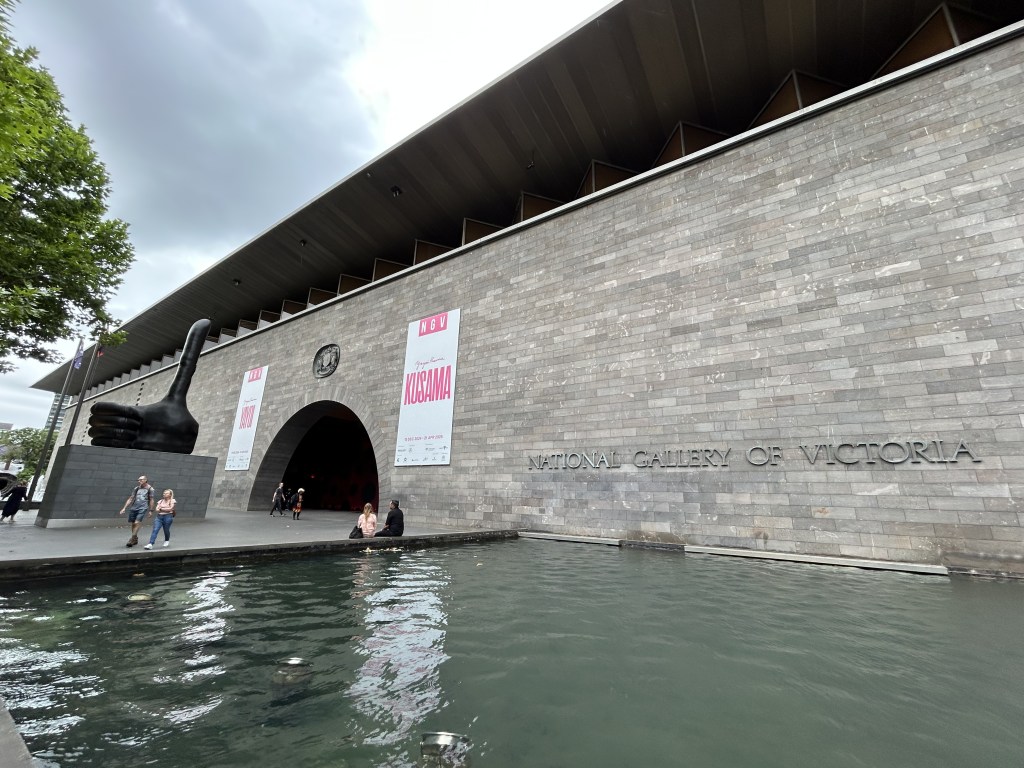
A full picture of the National Gallery of Victoria.
Rating: 4.5/5
The National Gallery of Victoria is located at South Bank, a cultural area filled with theatres, art centres and galleries. While it looks like cultural heritage from the outside, the interior design is modern: the atrium ceiling was made of square glass windows.

The glass window (upper) and an artwork by a Japanese artist (down).
The curators arranged displayed items by country and period. During my visit, the Korean and French art were more memorable to me. I visited a French couture fashion exhibit. It was interesting to see the embroidery techniques used by Parisian couture houses in the mid-80s to the 90s to create beaded evening gowns and dresses.
An embroidered evening gown, belt and shoes designed by Karl Lagerfeld in 1996.

I also saw another cultural trend in the museum. Traced back to the late 17th century, a cabinet adornment culture was renowned in France. The cabinets were decorated with brass lines, a style that was revived in the 19th century.
A writing cabinet made in 1845 in France.

Another section I liked was the Korean arts. In particular, the museum displayed ceramics and decorative art from the 9th century to the 18th century. I found two interesting pieces of porcelain with cultural significance. Early Korean ceramic production reflects an appreciation for nature and minimalism.
A moon jar from the 13th to 18th centuries demonstrated the use of white glaze in stoneware production.

The museum also displayed a foldable panel that serves as a decorative and functional piece of art for bedrooms or living rooms.

A panel folding screen with lotuses from the Joseon dynasty (1392-1897).
I was captivated by another piece, a celadon porcelain with its jade-coloured glaze. There were ornaments assembled on the jar, featuring a unique cloud design from the 9th to the 13th centuries. It was beautiful and precious.

A jar with inlaid crane and cloud design from the Goryeo dynasty, from 918 to 1392.
In the 13th-to-16th European art section, I found a painting by Claude Monet. I like his floral paintings the most, but the curators showed an impressionist landscape this time. I liked how he painted the sky and the Seine River. It was colourful and romantic. It was an iridescent impressionist hue that he used, which brought the summery view to life.

Claude Monet’s Vetheuil (oil on canvas in 1879).
If you have a free day, you should consider visiting this museum. It is relaxing to take a boat trip to the South Bank, visit the museum, and finish the afternoon at a nearby coffee shop.


Leave a comment