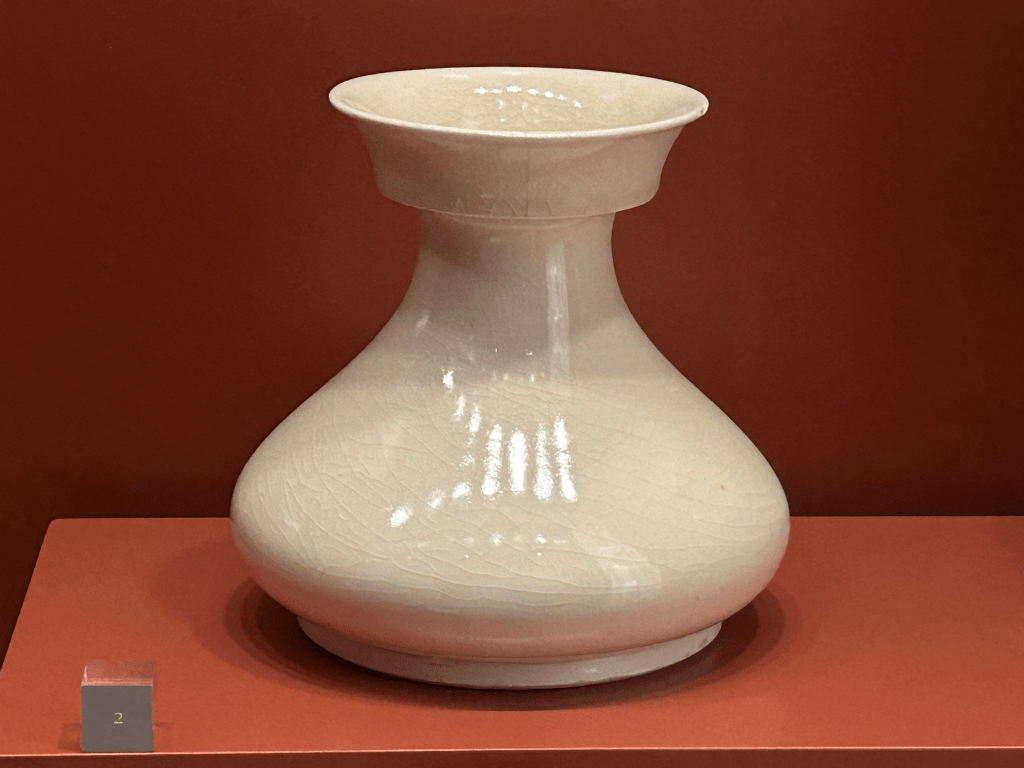
White-glazed porcelain from the Tang Dynasty (618-907).
Rating: 4.5/5
Located on the second floor of the Hong Kong Heritage Museum is T. T. Tsui’s Gallery of Chinese Art. Mr Tsui was a businessman and a connoisseur. To share his love for Chinese art with a broader audience, he set up the Tsui Art Foundation, which has donated countless artworks to national museums and galleries in various places. This museum received over 700 art pieces from 7000 BC to the 19th century. The permanent exhibition of Tsui’s collection comprises donated antiquities and selected artworks. It was an eye-opening visit because of the enormous collection of antiques from major dynasties built on ancient China’s legacy and cultural diversity.
The exhibition is informative and educational. It is divided into 5 zones with 4 themes: food and drinks, entertainment, belief, and animals. The Chinese antiques are arranged in a sequence of time and about a subject matter in a themed zone. For example, to highlight the differences in colours and skills required for making white porcelain in different dynasties, curators display clay bodies from the Tang and Song dynasties in the same area.
A flower-patterned white porcelain bowl from the Song Dynasty (960-1279). It captures the blooming of chrysanthemums.

Apart from white-glazed porcelain (白釉瓷), the zone also presents clayed bowls and pots of other styles. I like the underglaze blue porcelain (青花瓷) collection because it shows how ancient people creatively used the glaze to make various patterns on different shapes and sizes of clay bodies. In addition, the cobalt blue pigment goes with the natural tone of the clay.

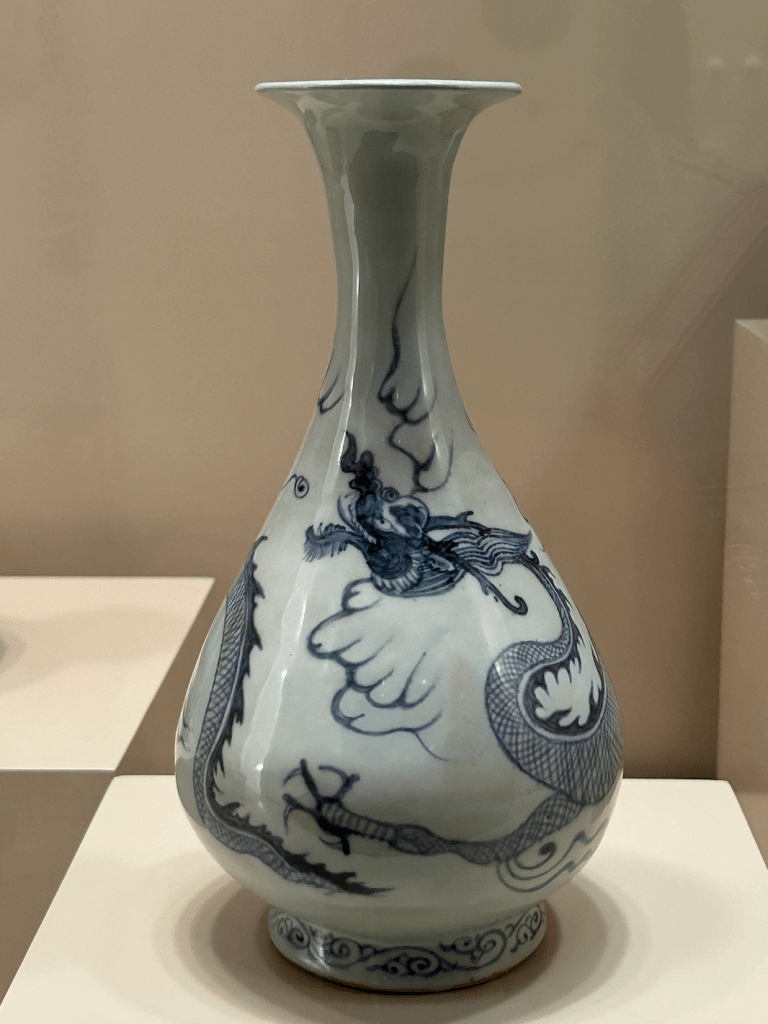
Pear-shaped underglaze blue vases with designs featuring ducks (left) and a dragon (right) from the Yuan Dynasty (1279-1368).
Another adjacent glass cabinet displays Qingbai (also named blue-white glaze) wares (青白釉瓷). It is yet another coloured glaze applied on porcelain, only that Qingbai glaze is on the edges of layers. Each type of glaze is explained with an information box. With some text curations, this has made comparison possible for even an outsider like me.

A pair of flower-patterned Qingbai vases showing branches of plum blossoms from the Yuan Dynasty (1279-1368).
Tsui’s collection has reflected the cultural and historical contexts of ancient China. The ceramics antiquities are containers of Chinese ideology and history. The Tang Dynasty was an era of prosperity that enabled goods production and trading. It also encouraged the development of different art forms. One of the popular art forms was poems. At that time, poets often personified flowers to bring out symbolic meanings. For instance, plum blossoms, orchids, chrysanthemums, and bamboo (梅蘭菊竹) were referred to as Four Gentlemen (花之四君子) with admirable characters. Mainstream cultures, such as literature, endured (尚文風氣) throughout the Song and Yuan dynasties.
There is a visit-only area called A Glimpse of TSUI’s Collection. Unfortunately, no photos are allowed. The exhibition starts with a long rectangular cabinet holding a script of paintings by Huang Yongyu, a famous Chinese painter, Tsui’s friend, which is like a preface for this unique selection of artworks. The main area displays twelve small delicate porcelain cups, each with a painting of a flower type complemented by a poem about the flower. One of the favourite activities of ancient Chinese literati was flower appreciation (賞花). Kangxi, a Chinese emperor in the Qing Dynasty renowned for his aptitude for literature, took it far by ordering the making of such a set of floral drinking wares. He asked for two sets, which became Tsui’s collection. The breadth of his Chinese art collection is astounding.
A small portion of the antiques kept in the museum is from somewhere other than China. There is a four-layer automaton clock from London. It was meant to be a gift/a trading good for someone significant. The smooth glossy finish reflects the remarkable gilding technique of its craftsmen when it was produced approximately in 1785. The turning glass rods that resemble water are another prominent feature of this clock.

A musical and automaton clock created in the UK at the end of the 17th century.
Undoubtedly, anyone who enters this exhibition knows more about ancient China and art afterwards. The only downside is that you must have basic knowledge of Chinese traditions to fully understand the collection’s cultural implications because the curation is standard for a regular exhibition. The versatile collection and neat arrangement put the lives of the Chinese people in different periods of time in front of visitors’ eyes. Some art forms and styles still influence today’s artists in their paintings and designs, which are their ways of paying tribute to distinguished artists in history and means of preserving the cultures that might otherwise be wiped out. If you are looking for art with mesmerizing stories, this exhibition is totally for you. It is a permanent exhibition open to the public for free at the Hong Kong Heritage Museum.


Leave a comment